
“We say don’t smile until Christmas, but in your case you just shouldn’t smile.”
That’s the instruction I was given at the start of my first teaching job when I was a very young looking 21 year old. Behaviour in school was about adult control and pupil compliance.
I learned a lot in that first year. I was able to seamlessly step into any class, any year group and oversee afternoon teaching. I could run the room. But I noticed that when the children, who I taught in the afternoon classes got to the school gate at home time, a transformation took place. They were exuberant, animated and full of energy. Strikingly different from the quiet, subdued children in the classroom.
In my second year I moved to a nearby school with similar catchment, but there was a clear difference in ethos. Smiling was encouraged and expected! I noticed that in this school the staff had well “run” rooms but this happened in an environment that was explicitly caring and friendly. The children were exuberant, animated and full of energy - in school!
In both schools we had strong routines, which is crucial and has never left my practice. When this is done well, we give our children a feeling of autonomy as they can function with growing independence within the (elastic) boundaries. Our role in “controlling compliance” will ebb and flow throughout the year as our children develop and as they experience varying levels of stress/challenge. Where each school differed was in how we maintained these routines.
In the first it was firmly in the rigid compliance, approval based approach. Don’t give them an inch. Essentially we needed the children to fear falling short of our expectations. There was no ebb and flow in the adult control and boundaries were rigidly held to regardless of our children’s development, experiences or levels of stress/challenge. At best this means we can keep order throughout the school day but both adults and children will be heavily masking, which takes its toll on all of us!
In the second school we maintained these routines through our sense of being together as a little learning family. Our routines allowed for collaboration and we adapted our expectations to meet our children where they were at day by day. Emphasis on routines rather than rules made this easier to do without impacting on consistency.
There is no question, to the outside observer, the first school looked settled and seemed more in control. Children completed tasks, peer conflict wasn’t evident in the classroom. But they were not exuberant, animated and full of energy. A quiet, compliant child isn’t necessarily the same thing as a regulated, engaged child.
The second school looked less controlled. Tasks often changed path to follow the learning and children were supported to repair and navigate peer conflict. School should be the place for these skills to develop. In the first school the natural opportunities for these skills to grow were vastly reduced!
I learned from both schools. I learned that allowing children to be themselves, to be curious, to get things wrong is not a threat to adult control. I learned that a secure attachment between our learners and our educators is essential for going beneath the surface of running a classroom. I learned that my role as an educator is to understand, nurture and support my children as they navigate the big asks of being part of a school community. The goal of behaviour management has to be so much more than having a smooth school day.
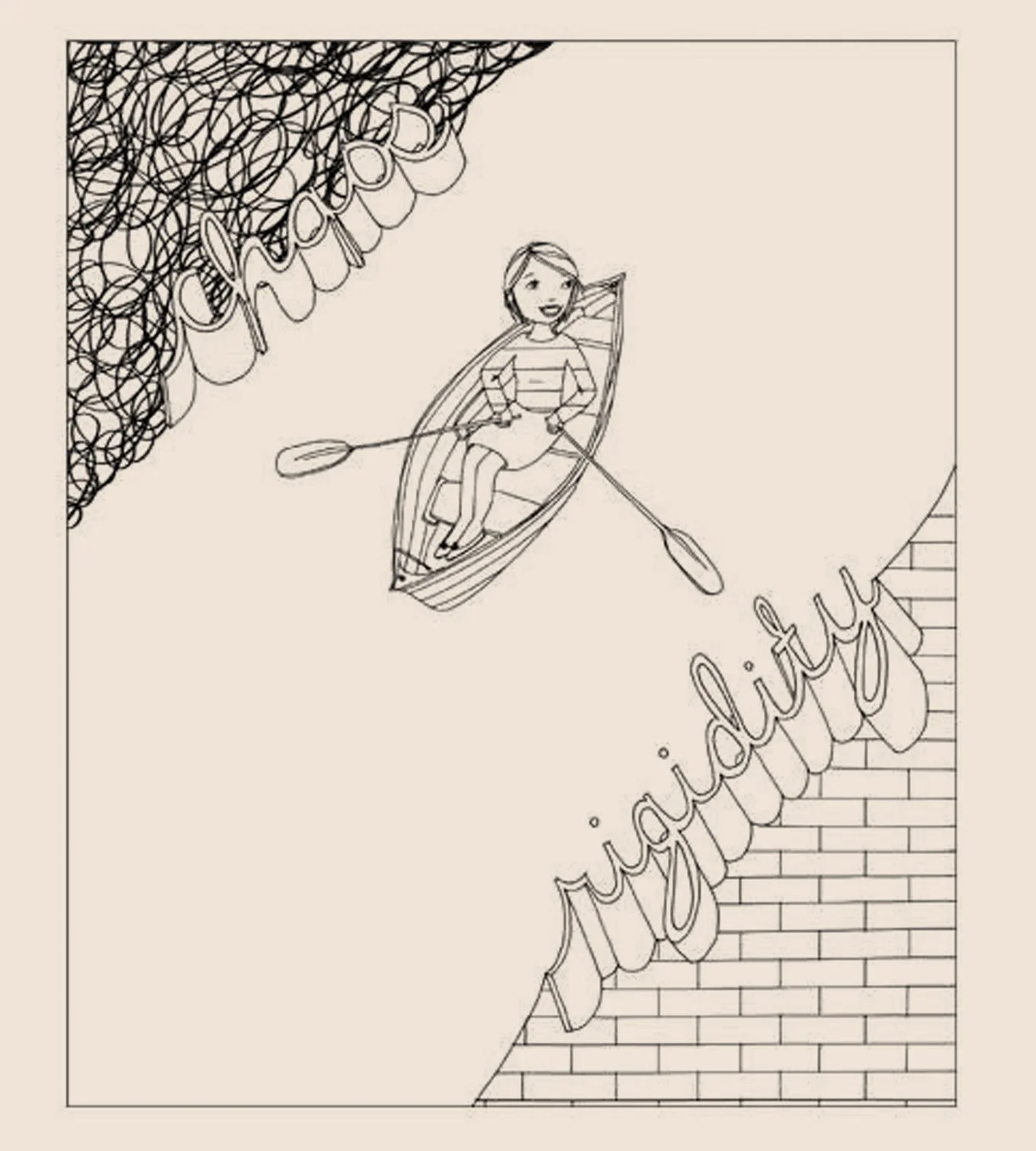
Dr Dan Siegel developed the “River of Integration” metaphor which has helped me make sense of my experience. It shows that optimal mental health and wellbeing flows dynamically between two extremes - chaos and rigidity. High levels of stress disrupts this flow pushing the nervous system toward either chaos or rigidity. As a team of educators our role is to support each other and our children to navigate back to the centre of the river, nurturing a state of stability and flexibility.
So in Olderfleet, when we are effectively running the room, our children are seen and heard.
And the adults are smiling
Rachel Galbraith, Principal
River of integration illustration taken from Dr. Dan Siegel.